
Managing a high-throughput warehouse on SAP Business One often reveals a stark operational bottleneck: your enterprise system knows what inventory you own, but it cannot dynamically optimize where that inventory should live or when it needs to move to the pick face.
Standard SAP Business One handling relies on static bin locations, manual reorder points, and periodic stock counting. As order volumes grow and SKU counts expand, relying on static rules leads to congested aisles, long picking travel paths, frequent stockouts at primary pick locations, and wasted labor.
By integrating a specialized Warehouse Management System (WMS) with SAP Business One, distributors and manufacturers unlock automated slotting optimization and predictive replenishment. Connecting dynamic warehouse execution software to core enterprise records transforms stock placement from a manual guessing game into an automated, data-driven workflow.
The Invisible Costs of Static Warehouse Operations
Enterprise Resource Planning (ERP) platforms excel at managing core financial ledgers, purchasing pipelines, and customer master records. However, standard ERP bin assignment logic treats warehouse space as static grid coordinates rather than an active, changing operational floor.
Operating without dynamic slotting and automated replenishment creates several hidden costs:
- Excessive Worker Travel Time: In a typical manual warehouse, up to 60 percent of a picker’s shift is spent walking between aisles. When fast-moving items are placed deep in the racking, travel costs escalate rapidly.
- Pick-Face Stockouts: High-velocity SKUs quickly run out at primary pick locations while bulk reserve pallets sit untouched nearby. Pickers arrive at an empty bin, forcing orders into hold status while a forklift driver is dispatched to locate reserve stock.
- Congested Travel Aisles: Placing multiple popular SKUs in the same warehouse zone creates traffic jams among pickers, slowing down fulfillment during peak order processing windows.
- Ergonomic Inefficiencies: Heavy items placed on high racking shelves or near floor level increase handling times and heighten worker strain, raising safety risks.
An integrated WMS solves these structural issues by taking real-time transactional data from SAP Business One and applying dynamic spatial algorithms to automate stock placement.
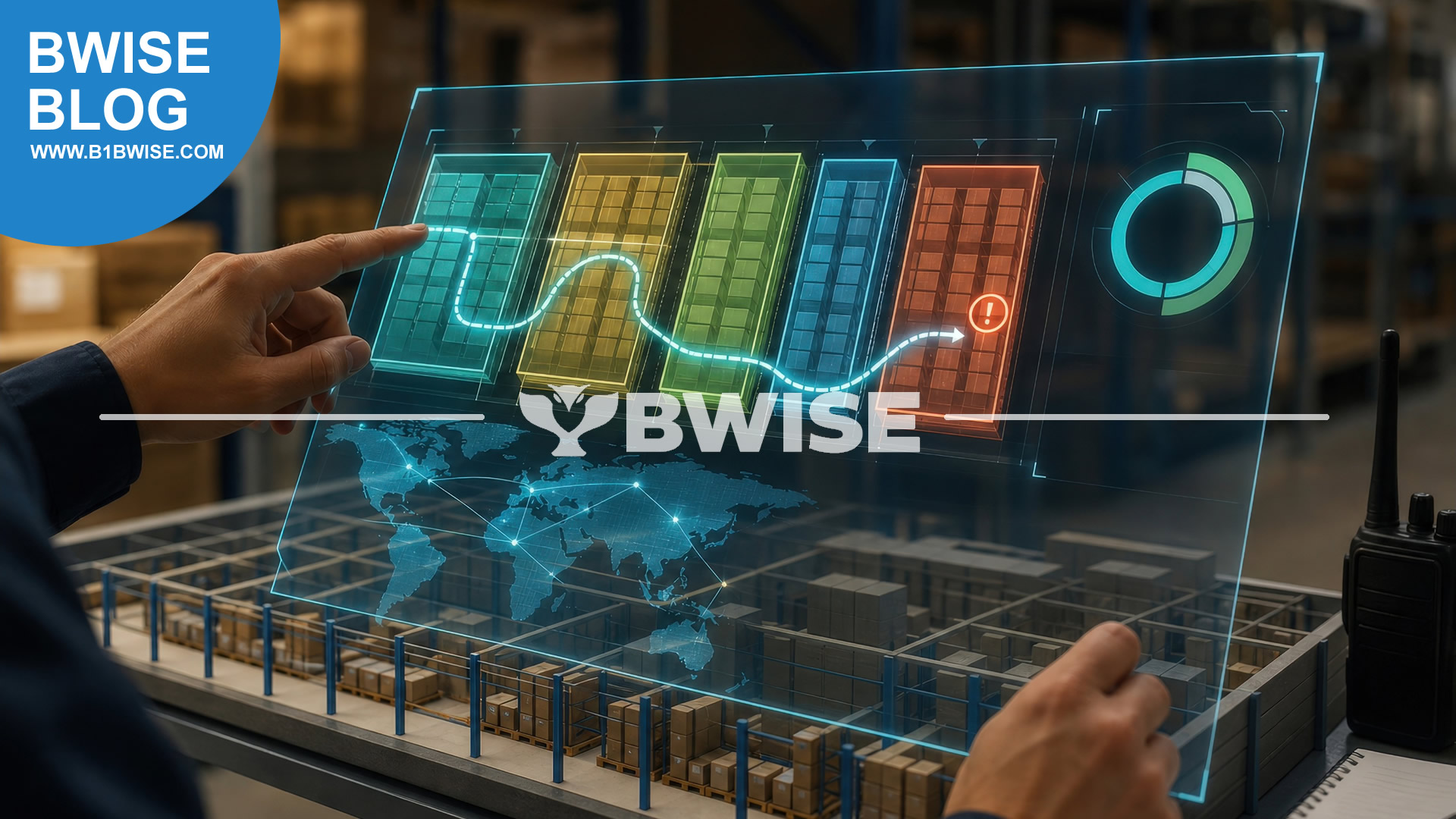
Dynamic Slotting Optimization: Real-Time Intelligence for Storage Space
Slotting optimization is the process of analyzing product sales velocity, physical dimensions, product affinities, and seasonal demand variations to place every SKU in its most efficient storage location.
A WMS integrated with SAP Business One automates this process by processing historical order data, current sales trends, and physical SKU characteristics.
Rather than conducting annual labor-intensive slotting reviews, an integrated WMS continuously calculates optimal bin assignments and generates step-by-step re-slotting tasks for warehouse staff during slow operational periods.
Key factors evaluated by automated slotting engines include:
- Velocity Zone Profiling: Fast-moving items (A-velocity SKUs) automatically shift to prime physical real estate near shipping docks at waist-level height (“golden zone” picking), while slow-moving items (C-velocity SKUs) move to higher or deeper storage bays.
- Order Affinity Analysis: Items frequently purchased together are automatically slotted in adjacent bins, allowing pickers to fulfill multiple line items in a single stop.
- Dimensional and Cubing Optimization: WMS algorithms calculate volume requirements based on master data attributes in SAP Business One, preventing undersized bins from overflowing or oversized bins from wasting space.
- Seasonal Demand Shifts: As product demand shifts throughout the year, the WMS automatically adjusts target bin assignments weeks before peak sales cycles begin.
Predictive Replenishment: Moving Stock Before Pickers Arrive
Slotting optimization ensures items live in the right locations, but predictive replenishment ensures primary pick locations never run dry.
Traditional ERP replenishment relies on static minimum and maximum bin thresholds. Under static rules, a replenishment task triggers only after a pick bin drops below a set inventory count. In high-volume environments, this reactive approach causes frequent delays: by the time the system alerts a forklift driver, multiple pickers are already waiting at an empty bin.
Predictive replenishment turns reactive alerts into a forward-looking operational workflow:
- Demand Wave Analysis: When a wave of sales orders flows from SAP Business One into the WMS, the software evaluates total required quantities against current inventory levels at active pick faces.
- Proactive Move Generation: If projected wave demand exceeds available pick-face stock, the WMS generates bulk-to-pick replenishment tasks before releasing the picking tasks to staff.
- Optimized Task Interleaving: The WMS routes forklift operators to drop off reserve pallets at primary pick locations while completing routine putaway trips, eliminating empty vehicle travel across warehouse aisles.
By anticipating demand spikes rather than reacting to stockouts, predictive replenishment eliminates picker downtime and maintains high fulfillment speeds.
Architectural Best Practices for SAP Business One Integration
Achieving seamless slotting and replenishment requires a clean, reliable integration layer between SAP Business One and your chosen WMS platform.
To maintain system speed and data integrity, follow these technical guidelines:
- Use the SAP Business One Service Layer: Leverage RESTful APIs through the SAP Business One Service Layer to process high-frequency WMS inventory moves, bin transfers, and stock adjustments without impacting core database performance.
- Establish Single Master Data Sources: Maintain item master attributes such as weight, length, width, height, and unit-of-measure rules directly in SAP Business One, allowing the WMS to inherit clean data for cubing calculations.
- Decouple Task Execution: Ensure the WMS manages real-time warehouse execution independently, passing summarized inventory movements back to SAP Business One asynchronously to keep financial ledgers fully synchronized.
Transforming Warehouse Operations into a Competitive Advantage
Automating slotting optimization and predictive replenishment moves a warehouse from reactive troubleshooting to structured, predictable execution. Integrating a specialized WMS with SAP Business One bridges the gap between enterprise-level financial planning and floor-level physical management.
By minimizing picker travel distances, eliminating pick-face stockouts, and optimizing physical space, distributors maximize their existing warehouse footprints and labor resources. The result is lower operational costs, faster order turnaround times, and an enterprise foundation capable of scaling alongside your business.